Processing an off-process order
From requisition to payment, these cost reference figures show a difference of EUR 101 per order with an adapted process.
Source: Mastercard (reference figures provided).

SOURCING FORCE · CLASS C & TAIL SPEND
Bring together the small purchases that take up your teams’ time. Sourcing Force combines procurement software, artificial intelligence and catalogues with BME expertise, alongside your ERP or P2P tools.
From a site request to purchase tracking. Within your rules. Explore pricing and prepare your quote.
Market reference figures
From requisition to payment, these cost reference figures show a difference of EUR 101 per order with an adapted process.
Source: Mastercard (reference figures provided).
A compliance and visibility challenge in a tail spend market estimated at EUR 300 billion for European companies.
Sources: McKinsey and Mastercard (reference figures provided).
Supplier onboarding costs EUR 200–500, followed by EUR 70–200 in annual maintenance per supplier.
Sources: McKinsey and Mastercard (reference figures provided).
These industry reference figures are not Buy Made Easy customer results.
A one-off supplier need not become another ERP record.
Sourcing Force + Buy Made Easy
Emailed quotes, new supplier records and urgent orders: the purchase value does not reflect the work involved.
Sourcing Force brings class C purchases into an AI-assisted P2P application connected to your ERP or S2P.
Buy Made Easy becomes your single supplier for outsourced purchases: one contact to coordinate suppliers and operations.
Inside Sourcing Force






 ISO 9001:2015
 ISO 27001
 Bronze
 FT1000 · 2026
Purchase value is only part of the picture
Finding a quote, creating a supplier record or chasing approval: one-off purchases take up a disproportionate share of your teams' day.
Class C covers low-value purchases within an ABC analysis. Tail spend refers to fragmented spend with less oversight. Low value does not mean low criticality.
Emails, quotes, calls and off-process purchases.
Onboarding, rekeying, follow-ups and reconciliation.
Spend that is difficult to reconcile across sites.
Match the approach to each class
Select a class to compare spend profiles and oversight needs. Low value does not mean low criticality.
Combine software and outsourcingA specialist application within your IT landscape
Your ERP or S2P remains the system of record; Sourcing Force brings together specialist purchasing workflows, suppliers and services.
Your organisation
Your requesters and sites
A specialist point of access
Third-party application · class C & tail spendYour suppliers
For purchases assigned to BME, suppliers already registered with BME avoid the need to create a new record in your supplier master.
Already deployed with







Connectable through supported standards
APIs · PunchOut workflows · data exchange
See the product in action
Watch the solution overview and prepare your questions for a demo tailored to your organisation.
Procurement artificial intelligence
Procurement AI connects information, prepares requisitions and highlights discrepancies. Your teams focus on the exceptions that matter.
Items · quantities · prices
Extract → qualify → structure
Product references and line itemsOrganised
Documents and informationMatched
Discrepancies detectedFlagged
Extract useful information from a quote — supplier, items, quantities and prices — to prepare a structured purchasing file.
Organise the requirement, identify missing information and prepare to direct it to the appropriate purchasing workflow.
Turn the information collected into an actionable purchase requisition with its line items and supporting documents.
Check that the expected documents are present and consistent, then highlight the points needing review.
Bring supplier information together and flag inconsistencies relevant to reviewing the purchasing file.
Compare bank details with the information in the file to identify discrepancies to resolve before payment.
Organise the customs data and documents needed for an international purchase and highlight missing information.
Compare line items, quantities and amounts across the three documents to highlight discrepancies.
Identify inconsistencies in purchasing data and help the team prioritise their review.
Prepare supplier searches and response comparisons based on the stated requirement.
When autonomous mode is enabled, let the autonomous workflow carry out sourcing within the agreed scope.
When autonomous mode is enabled, let the autonomous workflow negotiate within the limits defined for the project.
Autonomous mode. When enabled, sourcing or negotiation can run without human intervention, within the limits and escalation rules defined with your organisation.
Integrated AI tools
 Mistral AI
 OpenAI
 Anthropic
From request to visibility
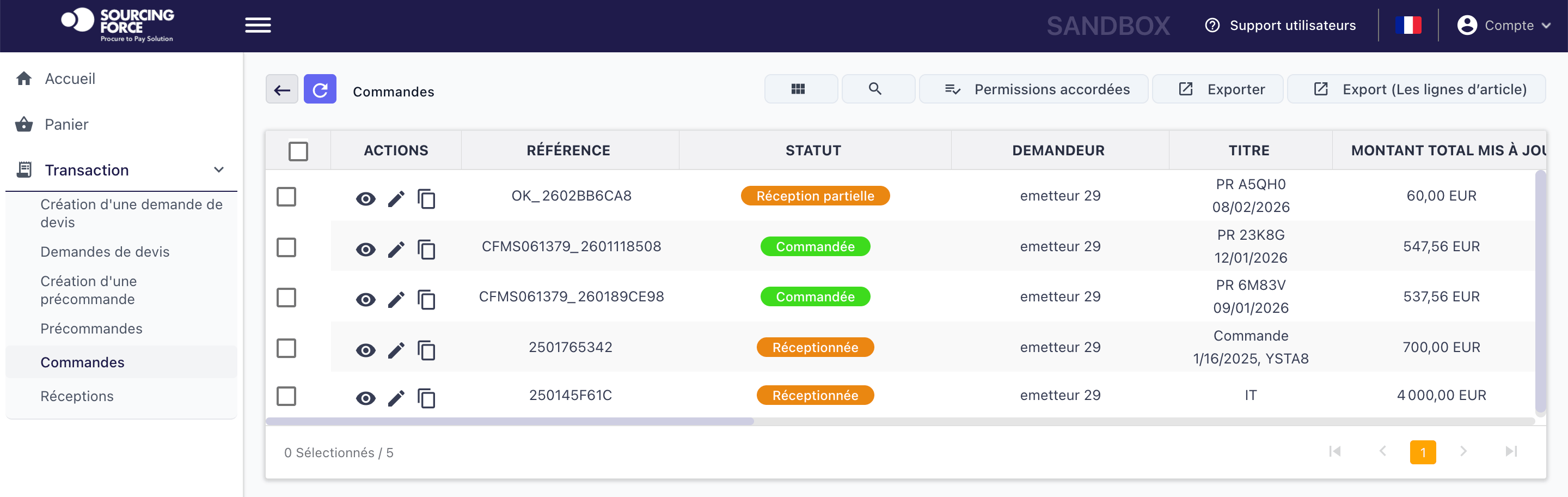
Move each request forward with the right information and the right contact.
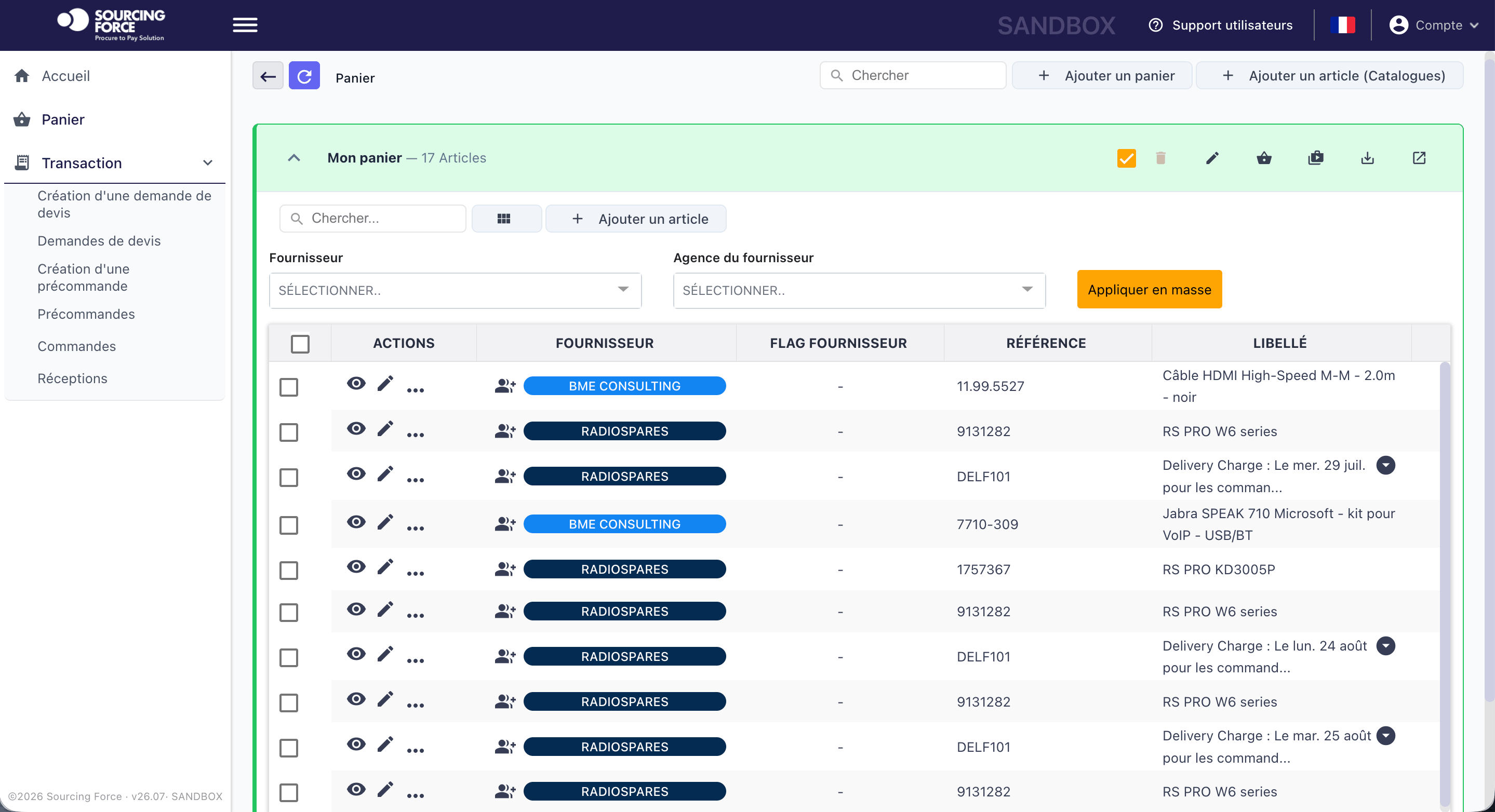
The requester specifies the requirement and site, and attaches the quote.
Requirement + contextCatalogue, PunchOut or supplier search: the workflow depends on the requirement.
Items + documentsThe requisition enters the agreed approval and ordering process.
Rules + approversTeams can see progress and data for the purchases in scope.
Receipt + visibilityAdministrative cost, step by step
Defining the requirement, ordering, receiving and accounting: each order involves several roles. The BME model measures the time and cost of this complete process.
Catalogues, automation and outsourcing simplify the steps that take up your teams' time.
Before
€189.84161 minutes / orderWith Sourcing Force / BME
€5850 minutes / order111 minutes and around EUR 130 saved per class C order in the BME model.
One portal, several purchasing workflows

Technical specifications, urgent requirements and multiple distributors make small industrial orders difficult to manage.
Explore the process →
An order for gloves or footwear still needs the right size, product reference and specifications for the task.
Explore the process →
Without a defined deliverable, method and deadline, a one-off testing service becomes difficult to accept on completion.
Explore the process →
Technicians need parts and services quickly while allocating each purchase to the right site or project.
Explore the process →
Separate orders for each warehouse make specifications and delivery dates difficult to reconcile.
Explore the process →
Adapters, monitors and peripherals are often bought urgently from several distributors.
Explore the process →
A marketing campaign brings together printing, point-of-sale displays and promotional items from different suppliers.
Explore the process →
A one-off assignment becomes harder to track when requirements, deliverables and approvals are scattered across separate conversations.
Explore the process →
Hotels, venues, transport and MICE services create fragmented bookings, sometimes committed outside the procurement process.
Explore the process →Application and operational expertise
Your teams choose what to retain and what to outsource. The software organises the workflow; BME carries out the outsourced operations agreed with you.
Software and services can be combined or used separately. BPO partners can also use the application for their own operations.
Requisitions, catalogues, automation, tracking and data.

Assigned purchases, suppliers and agreed operations.
Inside organisations
Hospitality
In 2021, BME supported Accor's head office with digital procurement outsourcing and catalogue access within its ordering process.
Read the Accor case study (French) ↗Manufacturing
Supplier rationalisation and centralised class C purchasing for the access solutions group.
Read the ASSA ABLOY case study (French) ↗Pharma
A single point of access for tail spend purchases across production sites.
Read the Mayoly Spindler case study (French) ↗
Energy
At Rolls-Royce Nuclear, BME rationalises the tail spend supplier base.
Read the Rolls-Royce Nuclear case study (French) ↗Manufacturing / HVAC
Digital oversight of spend scattered across the compressor manufacturer's sites.
Read the Tecumseh case study (French) ↗
Manufacturing / materials
A consolidated supplier base to reduce administrative and accounting work.
Read the Corning case study (French) ↗Automotive
Handling tail spend orders and centralising class C purchases.
Read the Goodyear case study (French) ↗Construction / technical services
Simplified class C transactions in the lift installation and maintenance sector.
Read the OTIS case study (French) ↗One tool. Your industry context.
Explore the purchases and constraints specific to your organisation.
 Pharma and life sciencesConsumables, laboratory equipment and traceability.
 ManufacturingMRO, maintenance, parts and urgent site needs.
 AutomotiveWorkshops, equipment and industrial consumables.
 EnergyFacilities, maintenance and specialist suppliers.
 Construction and technical servicesField services, tools and equipment.
 Transport and logisticsSites, handling equipment and operational team requirements.
 RetailStores, networks and one-off requirements.
 Public sectorPublic services and institutions.
 Events and travelBookings, venues and services for event and travel teams.
Your questions
Useful answers to help prepare your project.
Class C purchases are the lowest-value category in an ABC analysis of a company's spend. They may involve many one-off purchases and suppliers. Their small share of spend does not make them unimportant: an inexpensive part can be critical to a site.
Class C is an economic category derived from ABC analysis. Tail spend refers to fragmented expenditure that receives less procurement oversight. The two often overlap, but they are not identical. Indirect purchases are defined by their use in running the business.
Sourcing Force complements your ERP or S2P as a third-party application specialising in class C purchases and tail spend. Your organisation retains its systems of record and its rules. Your procurement and IT teams define the flows handled by Sourcing Force.
AI helps read quotes, structure requisitions, check documents and identify anomalies. Autonomous sourcing and negotiation are available only in a configuration where autonomous mode is enabled.
Sourcing Force organises the digital workflow and tracking. When operations are outsourced to BME Consulting, BME handles the activities defined in the contract, including supplier management and payments under the agreed arrangement. Responsibilities and financial flows are defined with your team.
Start with the orders and suppliers in scope, processing time and internal costs. Then compare the total cost of your current process with the proposed arrangement, including service and integration fees. The free assessment and simulator help build this estimate; no savings figure is guaranteed.
Spot buying addresses a one-off need. Maverick buying takes place outside established processes or agreements. A one-off purchase can therefore follow all the rules. Value, frequency and compliance are three separate dimensions.
Identify suppliers used infrequently, then group the purchases that can be handled by an operator such as BME. Within the agreed contractual scope, this can reduce the number of direct administrative relationships you manage while retaining access to useful sources of supply.
A PunchOut catalogue gives users access to a supplier's website from their purchasing workflow. Users build a cart on that site, then bring it back into the requisition and approval process. With a hosted catalogue, users select items directly in the application instead.
The VMS provides the software for managing external services; the MSP provides operational support. In the combined offering, Sourcing Force provides the technology and BME can act as the MSP. The services and functionality in scope are defined for each project.
The project starts by defining the data to exchange, the systems of record and the approvals to retain. Your IT team and the relevant suppliers then determine how to connect them. Coupa is among the environments already connected within the offering; the protocol and data flows need to be specified for your project.
Sourcing Force and BME services are priced on request. The software scope, the services assigned to BME and the connections to your IT systems determine the proposal. A demo helps clarify your requirements before pricing.
Your next step
Let's discuss your class C purchases and how your organisation works.
Estimate your potential savings for free.