The need is known
For regularly used offerings, consider a hosted catalogue or PunchOut. The requester selects items through the agreed workflow; the client's rules determine approval and ordering.
Compare supplier catalogues ↗
Your challenges · Dispersed requests
A consumable to replenish, a quote already received, a one-off service: each may need a different workflow. Give requesters a clear starting point and procurement teams usable information.
Sourcing Force + Buy Made Easy
Supplies, on-site work and services arrive through different channels, with limited visibility of progress.
Sourcing Force centralises one-off indirect purchases and organises their preparation, approval and tracking.
Buy Made Easy acts as the single supplier for outsourced operations, reducing account creation and scattered communications.
Choose the right scope
Indirect purchases meet an organisation's operating needs. They cover very different situations. This page focuses on low-value purchases and one-off requests whose fragmented nature makes them harder to process.
An indirect purchase can be recurring and structured. A spot buy is a one-off purchase. Off-catalogue describes access to an offering, not frequency. Using these distinctions helps direct requests without treating all spend as class C.
Problems arise when each request takes its own path: a quote sent without context, information scattered across messages, a supplier needing assessment or a missing delivery site. Simplification starts by gathering useful information before trying to speed up processing.
Understand ABC classification and spot buying ↗Choose for the situation
For regularly used offerings, consider a hosted catalogue or PunchOut. The requester selects items through the agreed workflow; the client's rules determine approval and ordering.
Compare supplier catalogues ↗Gather the quote, supplier, items and relevant terms. Preparing the request makes this information available for the agreed approval workflow.
See request preparation ↗Specify the need, deadline and constraints. Depending on the chosen approach, the procurement team handles the work in-house or assigns operations to BME Consulting.
Explore BME outsourcing ↗A usable request
The Sourcing Force pre-order shows the supplier, branch, contacts, quote and line items. This existing screenshot illustrates request preparation.
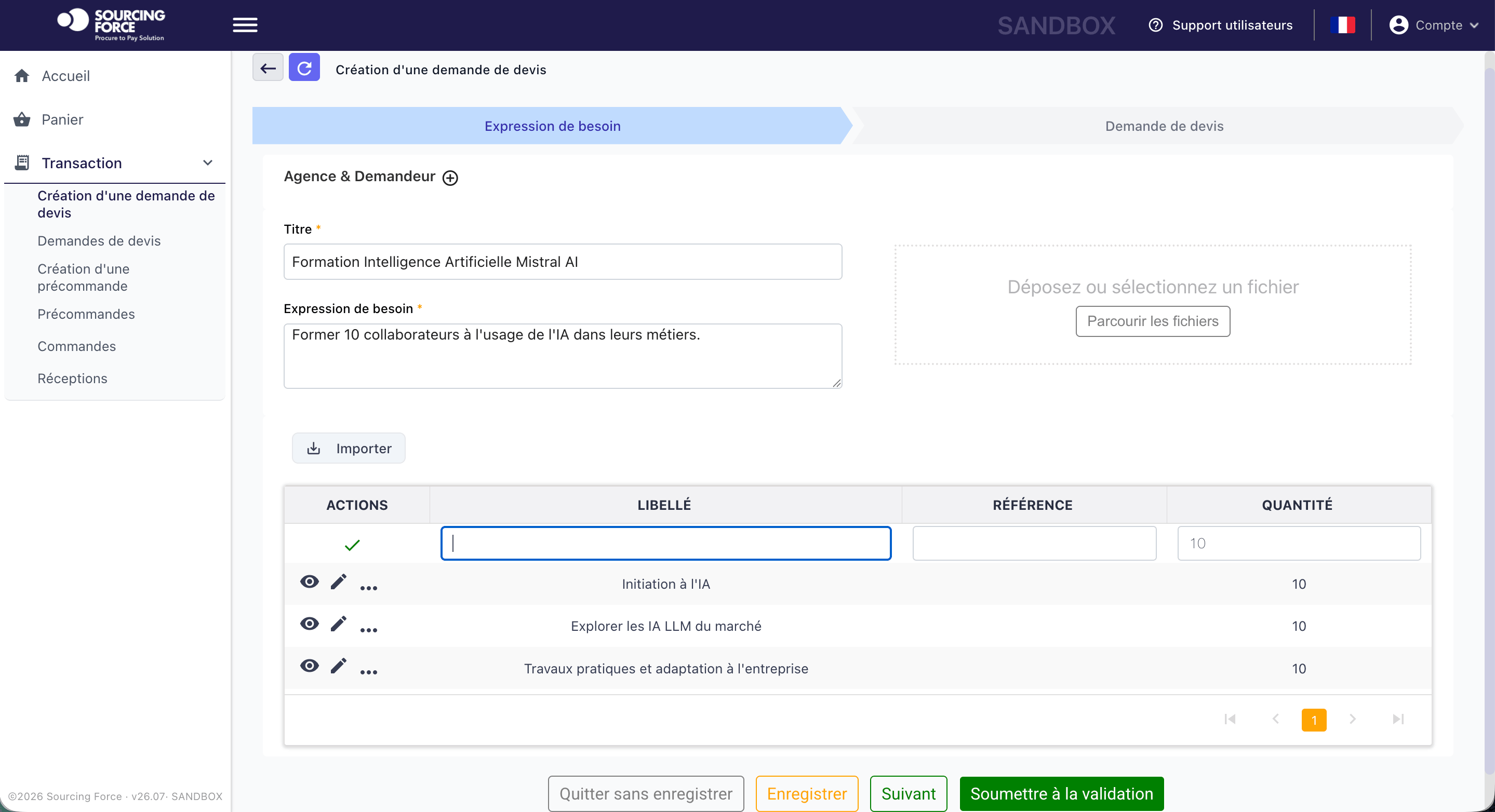
Before submission, check that the purpose, quantities and recipient of the purchase are clear. Additional information depends on your procurement policy and the nature of the request. The form does not replace the technical assessment of the product or service.
Handle exceptions
An urgent request should state the required date and the impact of delay. A new supplier needs an appropriate assessment. An incomplete quote needs clarification before commitment. Simplification makes the exception visible and helps route it correctly.
Sourcing Force's stated controls include spending limits, approval workflows and restrictions on suppliers or categories. Their configuration must match the application's agreed scope and the client's rules.
A requested deadline is not an approval. Your organisation identifies who can decide and which process to follow when an exception is allowed.
Who does what?
| Participant | Role in the workflow |
|---|---|
| Requester and procurement team | Describe the need, specify constraints and apply the responsibilities defined by the client. |
| ERP or S2P | Remain the system of record for rules, approvals, commitments and orders. |
| Sourcing Force | Structure requests and information, then track class C purchasing operations and tail spend. |
| BME Consulting | Deliver assigned outsourcing services if the client chooses to include them. |
The application and services can be used separately. Using the software does not mean that every purchase is outsourced. Procurement and IT teams define exchanges with the existing environment.
Prepare your ERP/S2P integration ↗One portal, several purchasing workflows

Technical specifications, urgent requirements and multiple distributors make small industrial orders difficult to manage.
Explore the process →
An order for gloves or footwear still needs the right size, product reference and specifications for the task.
Explore the process →
Without a defined deliverable, method and deadline, a one-off testing service becomes difficult to accept on completion.
Explore the process →
Technicians need parts and services quickly while allocating each purchase to the right site or project.
Explore the process →
Separate orders for each warehouse make specifications and delivery dates difficult to reconcile.
Explore the process →
Adapters, monitors and peripherals are often bought urgently from several distributors.
Explore the process →
A marketing campaign brings together printing, point-of-sale displays and promotional items from different suppliers.
Explore the process →
A one-off assignment becomes harder to track when requirements, deliverables and approvals are scattered across separate conversations.
Explore the process →
Hotels, venues, transport and MICE services create fragmented bookings, sometimes committed outside the procurement process.
Explore the process →Context from customer stories

BME's publication describes supplier base consolidation for class C purchases, across a variety of categories and industrial sites.
Read the BME case study (French) ↗
BME's account presents the centralisation of class C purchases and supplier rationalisation. It illustrates the operational challenge of handling dispersed orders.
Read the BME case study (French) ↗Improve over time
Similar requests, a frequently used supplier or recurring quotes may reveal a need for a more structured process. Observe this pattern before choosing a catalogue or adapting how requests are handled.
Spend analysis connects suppliers, categories and activity. Add feedback from requesters: spend data alone does not describe every difficulty in the workflow.
Analyse spend and priorities ↗A free Tail Spend Assessment can start this work. To explore request preparation and tracking, ask for a demo focused on your actual situations.
Prepare your project
No. Off-catalogue describes how you access an offering; spot buying describes a one-off need. A recurring request may remain off-catalogue until a suitable workflow has been organised.
Start with the quote, supplier details, expected items or services, delivery site and required date. Your procurement policy determines mandatory fields and any additional documents.
Identify the impact and required date, then follow your organisation's exception process. Urgency must be assessed and documented; it does not authorise bypassing approval or committing an order outside the system of record.
Your next step
Let's discuss your class C purchases and how your organisation works.
Request your free assessment.